Vol. 38 No. 3&4 (1997) is now online!
2023-11-09
Vol. 38 No. 3&4 (1997) is now online!
Access it at https://sillimanjournal.su.edu.ph/index.php/sj/issue/view/55
Read more about Vol. 38 No. 3&4 (1997) is now online!

Welcome to the second edition of Silliman Journal 2025, featuring six full-length articles and one research note.
The issue opens with a study by Katherine D. Maduro, Mary Hannah Lorraine S. Lauria, Gwyneth U. Lee, Maria Elizabeth H. Legaspi, Mitzi G. Malapitan, Gabriel Phoenix K. Manalili, Valerie Audrey P. Marcelo, and Tristan Jourdan C. Dela Cruz, which explores how online beauty content influences college students’ acceptance of cosmetic surgery and its possible effect on self-esteem. Their findings show that while such content significantly increases openness to cosmetic procedures, it does not affect self-esteem, suggesting that digital beauty culture shapes behavior more than self-perception.
The second article, authored by Jaruvic C. Rafols, Rochelle Marie C. Remollo, Maria Roiselle D. Nacu, Rea Mae A. Cadeliña, Lynnie G. Lacse, Edna Gladys T. Calingacion, Johanna Edith B. Rodriguez, Anna Lynn L.
Gio, Mewkam WS. Señerez, Sabinita P. Condicion, and Jessica B. Kitane, examines the challenges faced by college students in online distance learning. The study identifies unstable connectivity and power interruptions as major barriers, with most students turning to emotion-focused coping strategies, resulting in a generally moderate level of psychological well-being.
In the third article, Carla Melodillar investigates sources of conflict and conflict management styles among faculty in a higher education institution. She reports that task-related conflicts are most common and that faculty tend to use integrating and obliging strategies, showing a stronger concern for relationships than for authority, pointing to the need for initiatives that enhance collaboration and problem-solving skills.
The fourth article by Llewellyn I. Prejoles explores the social, health, and financial perceptions of long-term beneficiaries of the Pantawid Pamilyang Pilipino Program (4Ps). Despite over a decade of support, the study reveals persistent poverty and signs of dependency, underscoring the need for livelihood development, skills training, and values formation to enable self-reliance.
In the fifth article, Jan Cynth L. Palama and Dave E. Marcial analyze the relationship between students’ profiles and their use of online cheating tools during assessments. The study finds that students with higher technological proficiency are more likely to engage in academic dishonesty through search engines, AI tools, and other digital platforms, emphasizing the need for redesigned assessments, stronger integrity policies, and more engaging learning environments.
The sixth article, written by Marfy M. Cabayao, introduces panalaysayon, an emerging queer oral autobiographical form from Negros Occidental. By centering queer voices and shifting narrative perspectives, this hybrid storytelling mode challenges dominant literary structures and offers a compelling alternative framework for queer narratives in Philippine literature.
Accompanying these six articles is a research note by Floramae Joyce Neri, which documents a large-scale mangrove reforestation initiative in South Negros. Aiming to plant 500,000 seedlings across five municipalities, the project has already established over 141,000 seedlings with a 67% survival rate, demonstrating both environmental impact and strong community participation—most notably among women.
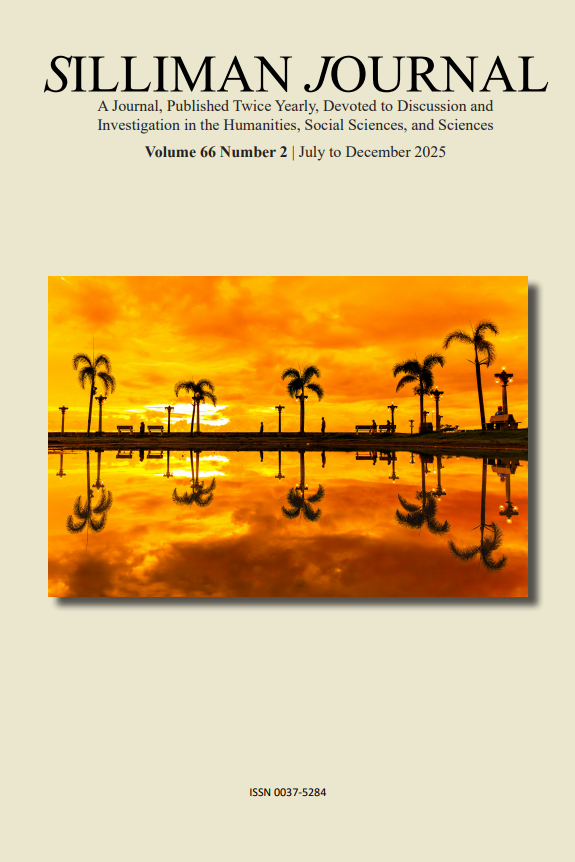
The cover art for this issue is by Silliman alumnus Nathaniel Carampatana, titled Morning Gift. Capturing the quiet beauty of a Dumaguete sunrise, the artist reflects on its “warm colors and reflections” as reminders of life’s balance, showcasing moments of calm that allow us to pause, breathe, and move forward.
Warlito S. Caturay Jr. , PhD